Study facts at a glance
Study size and structure: The randomized, open-label, single-center split-face study reported 31 completers, not 62 independent patients, over 28 days. Source 3
Treatments compared: One side received 2% supramolecular salicylic acid cream; the opposite side received 5% benzoyl peroxide plus adapalene gel. The title and methods specify 0.1% adapalene, but the objectives also contain a conflicting 0.01% figure. Source 3
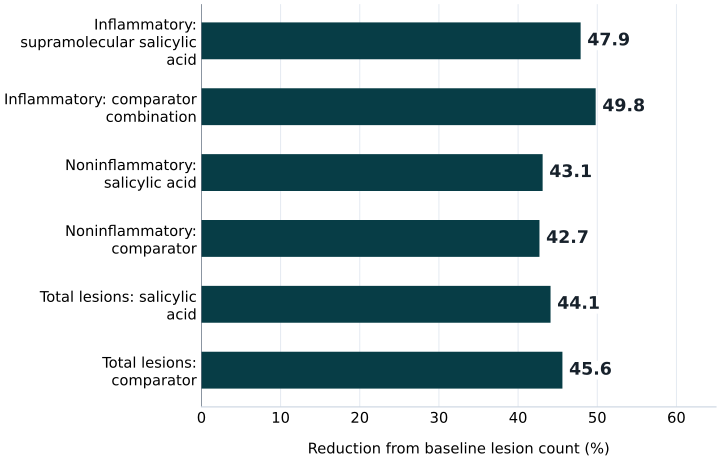
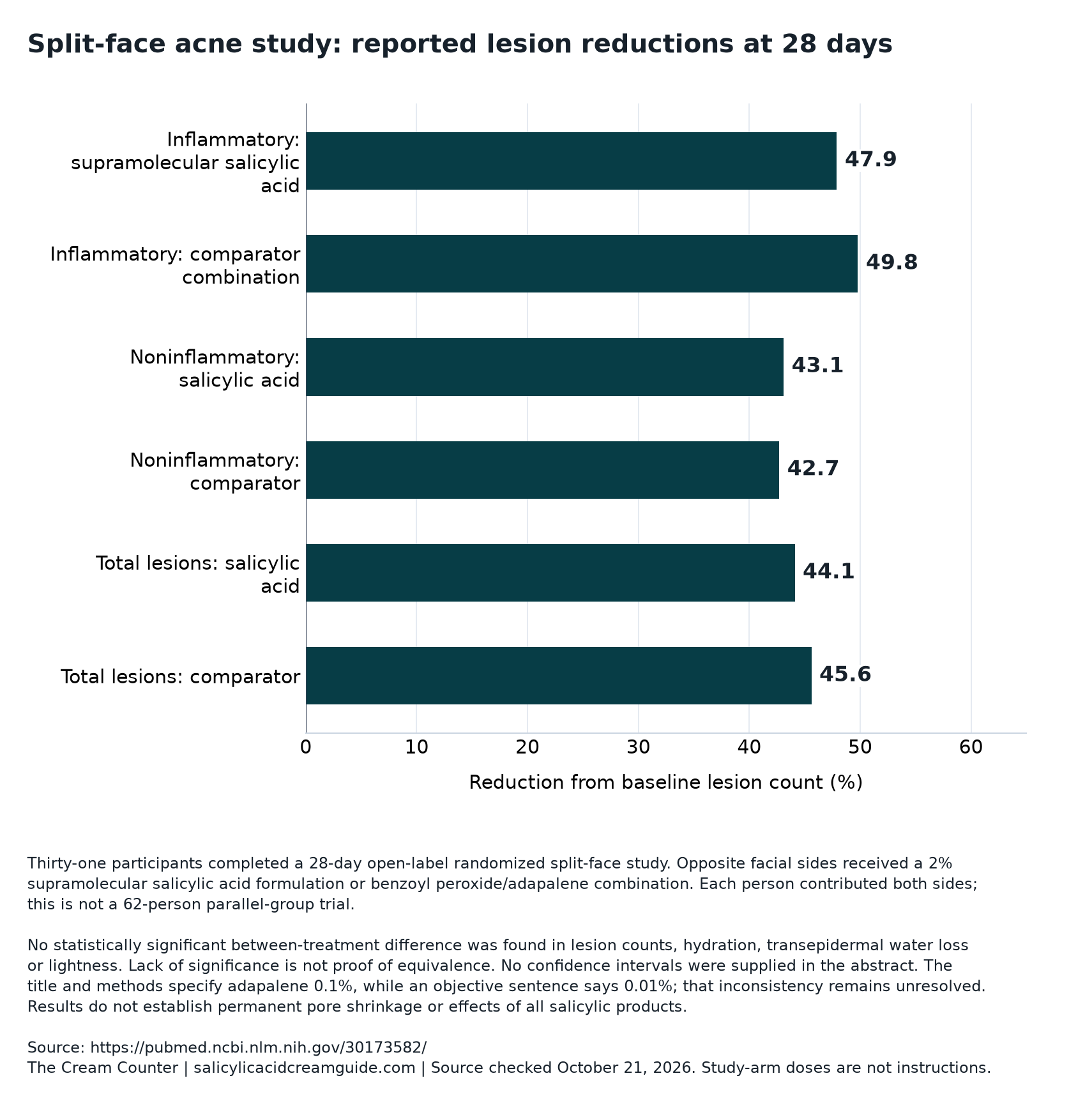
Total lesion counts: Reported reductions at day 28 were 44.1% with the salicylic acid preparation and 45.6% with the comparator; the between-side comparison was not statistically significant. Source 3
Skin measurements: No statistically significant between-side differences were reported for hydration, transepidermal water loss, brightness, or erythema indicators. Source 3
Separate combination evidence: A different 12-week trial compared chloroxylenol plus salicylic acid cream with benzoyl peroxide gel. It did not isolate salicylic acid’s contribution or establish formal equivalence. Source 1
What the split-face design actually compares
The main study enrolled people with mild to moderate facial acne and randomly assigned 2% supramolecular salicylic acid cream to one side of the face, with the benzoyl peroxide–adapalene gel on the opposite side. Investigators evaluated lesions and targeted-area side effects at baseline, day 14, and day 28. Skin measurements were taken at those same visits. These were topical study arms, not instructions for recreating the comparison at home.
Using both sides of one person’s face helps control characteristics shared across that person, such as age and much of their underlying acne tendency. But the two sides remain related observations. Thirty-one people completing a split-face trial do not become 62 independent patients merely because 62 facial sides were treated. Appropriate analysis needs to respect that pairing; the abstract does not provide enough statistical detail to independently check the approach.
The study was also open-label and conducted at one center. Treatment identity was not concealed under a blinded design, leaving room for expectations to influence assessments. Random side allocation is a strength, but it does not remove the separate limitations of short follow-up, a small sample, and unblinded evaluation.
Read the underlying chart data: download CSV or download the source-labeled chart.
The formulation and comparator deserve their full names
Supramolecular salicylic acid is described in the report as a modified salicylic acid preparation. The trial therefore concerns that 2% cream, not an interchangeable category of all 2% products. A matching active-ingredient percentage does not document matching delivery, vehicle, exposure, or clinical performance. The abstract does not provide a product-by-product bridge from the tested formulation to ordinary retail creams.
There is also an internal concentration discrepancy. The title and methods identify the comparator as 5% benzoyl peroxide plus 0.1% adapalene. The objectives text additionally states 0.01% adapalene, even while displaying the 0.1% combination notation. This article uses the title-and-methods description while preserving the conflict; it has not independently resolved it through the full paper.
That distinction matters because the comparator was not benzoyl peroxide alone. Results against a two-active gel answer a different question from results against a single-active gel. Our guide to reading a salicylic acid cream’s full formula provides a practical framework for keeping ingredient identity, concentration, and dosage form separate.
Reading the lesion reductions without turning them into clearance
At day 28, the reported reductions were close across three lesion categories. Papules and pustules are inflammatory lesions; noninflammatory lesions include comedones, commonly described as blackheads and whiteheads. Total lesion counts combine categories. The accessible abstract does not identify one outcome as a prespecified primary endpoint, so none should be elevated to that status here.
The total-count reductions differed by 1.5 percentage points, favoring the comparator numerically. That is a difference between reported percentage reductions, not a 1.5% difference in the chance of treatment success. Similarly, the noninflammatory result was 0.4 percentage points higher with salicylic acid, while the inflammatory reduction was 1.9 points higher with the comparator. Those small numerical differences do not establish a winner.
As an arithmetic illustration—not a reconstruction of participant data—a 44.1% reduction from 100 lesions would leave about 56. A reduction from 20 lesions would leave about 11. The same relative reduction can therefore accompany very different remaining burdens. These findings do not state how many participants became clear, how visible the improvement was to each person, or how satisfied they were.
Reported lesion-count reductions at day 28; differences are calculated from the reported percentages.
| Lesion category | 2% supramolecular salicylic acid | Benzoyl peroxide–adapalene comparator |
|---|---|---|
| Inflammatory lesions | 47.9% reduction | 49.8% reduction; 1.9 percentage points greater |
| Noninflammatory lesions | 43.1% reduction | 42.7% reduction; 0.4 percentage points smaller |
| Total lesions | 44.1% reduction | 45.6% reduction; 1.5 percentage points greater |
Why a nonsignificant difference is not equivalence
The abstract reports that the lesion-count comparisons were not statistically significant, with all reported P values above 0.05. In plain language, the analysis did not establish a difference under its statistical test. That is not the same as establishing that any true difference must be small enough to be clinically unimportant.
A formal equivalence question needs an acceptable difference specified in advance and an analysis showing sufficient precision around the treatment contrast. Confidence intervals would help readers see which differences remain compatible with the results. They are not provided in the accessible abstract, and neither is a formal equivalence margin. The authors’ description of similar efficacy should therefore be read as a pilot-study interpretation.
The initial enrollment denominator is also unavailable. Knowing that 31 participants completed the trial does not reveal how many started or why anyone may have stopped. Attrition cannot be calculated from the abstract. A larger, longer, appropriately analyzed study could clarify whether the apparent closeness persists and how precisely the treatments compare.
What hydration, water loss, and redness measurements add
The investigators measured skin water content and transepidermal water loss, or TEWL: water passing outward through the skin. They also recorded lightness and erythema indicators, labeled L* and a*. These measurements extend the study beyond counting spots, potentially helping distinguish changes in acne lesions from changes in surrounding skin properties.
No statistically significant differences between facial sides were reported for these measures. That does not establish that both treatments left every person’s skin unchanged, that neither caused irritation, or that their effects on the skin barrier were equivalent. A comparison between sides is a different question from whether either side changed from its own baseline. The abstract does not provide detailed trajectories or confidence intervals.
Although side effects were assessed, event frequencies and severity breakdowns are not available in the abstract. A redness instrument is not a complete record of burning, stinging, dryness, or allergy. The irritation guide keeps those experiences distinct from instrument readings. Four weeks of observations also cannot establish long-term tolerability or what happens after treatment ends.
The older cream trial tested a combination, not salicylic acid alone
A separate randomized, double-blind study followed 37 volunteers for 12 weeks. Nineteen were assigned benzoyl peroxide 5% gel and 18 received a cream containing chloroxylenol 0.5% plus salicylic acid 2%. In that study, participants applied their assigned medication to the entire face twice daily, with assessments at baseline and weeks 3, 6, 9, and 12.
At week 12, inflammatory lesion reductions were 60% with benzoyl peroxide and 62% with the combination cream; noninflammatory reductions were 54% and 56%, respectively. Between-group reductions were not statistically different. Because both an additional active ingredient and the vehicle differed, the comparison cannot assign the cream’s result specifically to salicylic acid. It also does not establish formal equivalence to benzoyl peroxide.
Erythema and photosensitivity were reported less often with the combination at week 12, with P values of 0.0002 and 0.05, respectively, but the abstract gives no event frequencies. That is a specific tolerability finding, not proof that the cream caused no adverse effects. The companion article on the salicylic acid combination trial examines this attribution problem in greater detail.
An add-on trial asks a third, different question
Another randomized study enrolled 49 patients with mild to moderate facial acne for 12 weeks. This prospective, single-blind comparison tested adding salicylic acid to clindamycin plus benzoyl peroxide against clindamycin plus benzoyl peroxide alone. Its design addresses an incremental treatment question, not whether salicylic acid alone can replace either background medicine.
The abstract reports results favoring the salicylic acid addition for inflammatory and total lesion reductions throughout the study weeks, noninflammatory reductions beyond two weeks, and end-of-study patient and investigator global assessments. However, numerical effect sizes, confidence intervals, and the salicylic acid concentration are not supplied. Statistical significance therefore cannot be translated into a specific expected extra reduction.
The additional benefit came with more mild to moderate transient dryness. Both regimens reduced stratum corneum hydration, while sebum values decreased with the salicylic acid addition. This is not a uniformly better-tolerated result. The salicylic acid and benzoyl peroxide guide explains why counting all active medicines matters; an antibiotic-containing trial should not be converted into a self-directed combination routine.
Three trials address different treatment questions and should not be pooled as though they tested the same cream.
| Study design and duration | Actual comparison | What the comparison addresses |
|---|---|---|
| 31 completers; randomized, open-label split-face; 28 days | Modified 2% salicylic acid cream versus benzoyl peroxide–adapalene gel | Short-term paired outcomes for two specific preparations |
| 37 volunteers; randomized, double-blind parallel groups; 12 weeks | Chloroxylenol–salicylic acid cream versus benzoyl peroxide gel | Combination-product performance, not salicylic acid’s isolated effect |
| 49 enrolled; randomized, single-blind comparison; 12 weeks | Salicylic acid added to clindamycin–benzoyl peroxide versus the background combination | Incremental effect of adding salicylic acid |
Source 2 Source 4 Source 1 Source 3
Lesion counts do not measure permanent pore shrinkage
The split-face study counted acne lesions and measured selected skin properties. It did not report a pore-diameter endpoint, permanent pore closure, scar remodeling, or sustained results after treatment stopped. Fewer comedones may matter to someone concerned about the appearance of congestion, but that does not turn a comedone count into a measurement of pore dimensions.
Likewise, no significant difference in the lightness index does not establish improvement in post-acne dark marks. A between-treatment brightness comparison is not a dedicated pigmentation outcome, and it does not show that either treatment erased marks. Acne activity, residual discoloration, and scarring are related concerns with different measurements.
FDA’s cosmetic background page describes salicylic acid as a beta hydroxy acid associated with exfoliation. That background does not supply a quantified pore-size or wrinkle benefit. The appropriate reading is endpoint-specific: lesion-count evidence supports statements about lesions, while durable structural or cosmetic claims require studies that actually measure those outcomes over a suitable interval.
Official labeling adds safety context the pilot cannot supply
FDA’s topical acne monograph lists salicylic acid concentrations of 0.5–2% and benzoyl peroxide concentrations of 2.5–10%, within a larger set of requirements. Being inside those ranges is not enough by itself to establish full conformity, and the monograph is not product-specific approval or evidence that two products are clinically interchangeable. Its labeling framework warns that combining topical acne medicines may increase irritation and dryness.
A separate FDA safety communication distinguishes ordinary local irritation from rare serious hypersensitivity involving some acne products containing salicylic acid or benzoyl peroxide. The responsible ingredient was not established: active ingredients, inactive ingredients, or both could have contributed. Throat tightness, breathing difficulty, faintness, or swelling of the eyes, face, lips, or tongue warrant stopping the product and seeking emergency care.
The historical report review included 131 reports, 58 hospitalizations, and 50 reports categorized as anaphylactic. Without a denominator of exposed users, those counts cannot estimate an individual user’s risk or compare ingredients fairly. They nevertheless identify a safety issue that a 31-completer trial cannot resolve. Small-area sensitivity checks do not guarantee that later allergy will not occur.
What belongs on a cream comparison checklist
The scientific checklist starts with the exact preparation, active ingredients, comparator, population, and time frame. It then asks which outcomes were measured and how much uncertainty surrounds the estimate. Here, the strongest direct statement concerns four-week lesion-count changes in people with mild to moderate facial acne using a modified salicylic acid preparation. It does not establish maintenance results, performance in other conditions, or superiority over a broad treatment category.
Editorial interpretation: when comparing a retail purchase or a prescription service, separate evidence questions from transaction questions. A promising study does not verify a particular provider’s formulation, consultation process, refill arrangement, or cancellation policy. The CoreAge Rx review and Likeness Rx review are places to check documentary terms, not evidence that either service supplies the studied preparation or reproduces its outcomes.
The accessible abstracts also do not establish sponsorship or funding details for these studies, and the split-face abstract lacks the full statistical methods and detailed adverse-event record. Those gaps limit independent appraisal; they are not evidence of misconduct. Results cannot automatically transfer to compounded products, oral routes, other formulations, or providers simply because salicylic acid appears somewhere in the offering.
Questions about the evidence
Did the split-face study show that salicylic acid works as well as adapalene?
Not as an isolated comparison. The other facial side received benzoyl peroxide plus adapalene, not adapalene alone. The study found close reported lesion reductions without statistically significant between-side differences, but the accessible abstract does not provide the confidence intervals or formal equivalence framework needed to establish equivalent performance.
Why does 31 completers matter if both facial sides were treated?
Each participant contributed a paired comparison. Their two facial sides share many characteristics and are not independent people. The design can reduce some between-person variation, but it does not double the participant count. The abstract also omits the starting enrollment denominator, so the completion count cannot be used to calculate dropout rates.
Can the older combination-cream trial identify how much salicylic acid contributed?
No. The cream contained both chloroxylenol and salicylic acid, and its comparator was a different active ingredient in a gel vehicle. Without an appropriate comparison that isolates salicylic acid, the observed improvement cannot be apportioned among the cream’s ingredients. Similar group results also do not, by themselves, establish equivalence.
Does unchanged TEWL mean there was no irritation?
No. The abstract reports no significant difference between sides in TEWL, not proof that every participant’s skin barrier stayed unchanged. Irritation also includes symptoms and events that a water-loss measurement cannot fully capture. Detailed adverse-event frequencies are unavailable in the abstract, while the separate add-on trial specifically reported more transient dryness.
Does a 2% label connect an ordinary cream to this trial?
It connects the stated concentration, not necessarily the formulation or clinical performance. The trial tested a modified supramolecular preparation. FDA’s monograph provides conditions for OTC acne products, but it is neither a head-to-head trial nor a guarantee that products sharing an active concentration will deliver the same benefits or adverse effects.
What this evidence supports
The split-face trial offers a useful preliminary finding: one modified 2% salicylic acid cream produced four-week lesion-count reductions numerically close to those of a benzoyl peroxide–adapalene gel in 31 completers. Its strongest contribution is a reason for better-powered, longer research, not a declaration of equivalence. The other trials reinforce the importance of the treatment question: testing a combination cream and testing an add-on ingredient are not the same experiment. For cream comparisons, keep the formulation, comparator, measured endpoint, and uncertainty attached to every result.
Research access and limitations
This analysis uses indexed primary study abstracts and official FDA material. Full trial protocols, supplements, and complete statistical and safety records were not examined. The split-face report’s adapalene concentration discrepancy remains unresolved; enrollment, attrition, confidence intervals, detailed adverse-event frequencies, and funding information were not available in its accessed abstract.