Study facts at a glance
Main study: The randomized, double-blind trial included 37 volunteers: 19 received 5% benzoyl peroxide gel and 18 received 0.5% chloroxylenol plus 2% salicylic acid cream for 12 weeks. Source 1
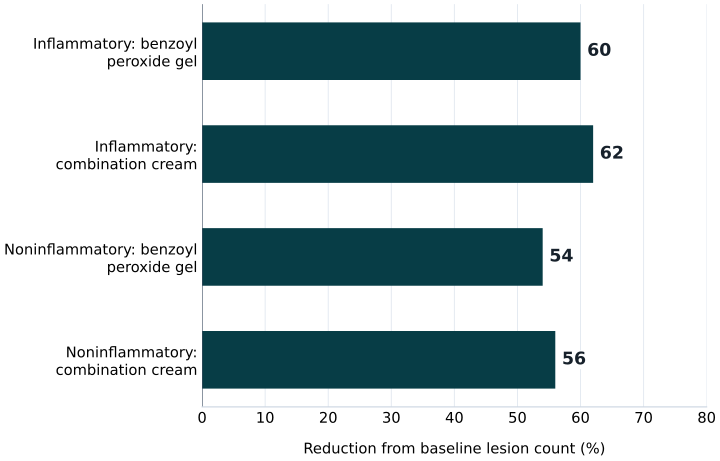
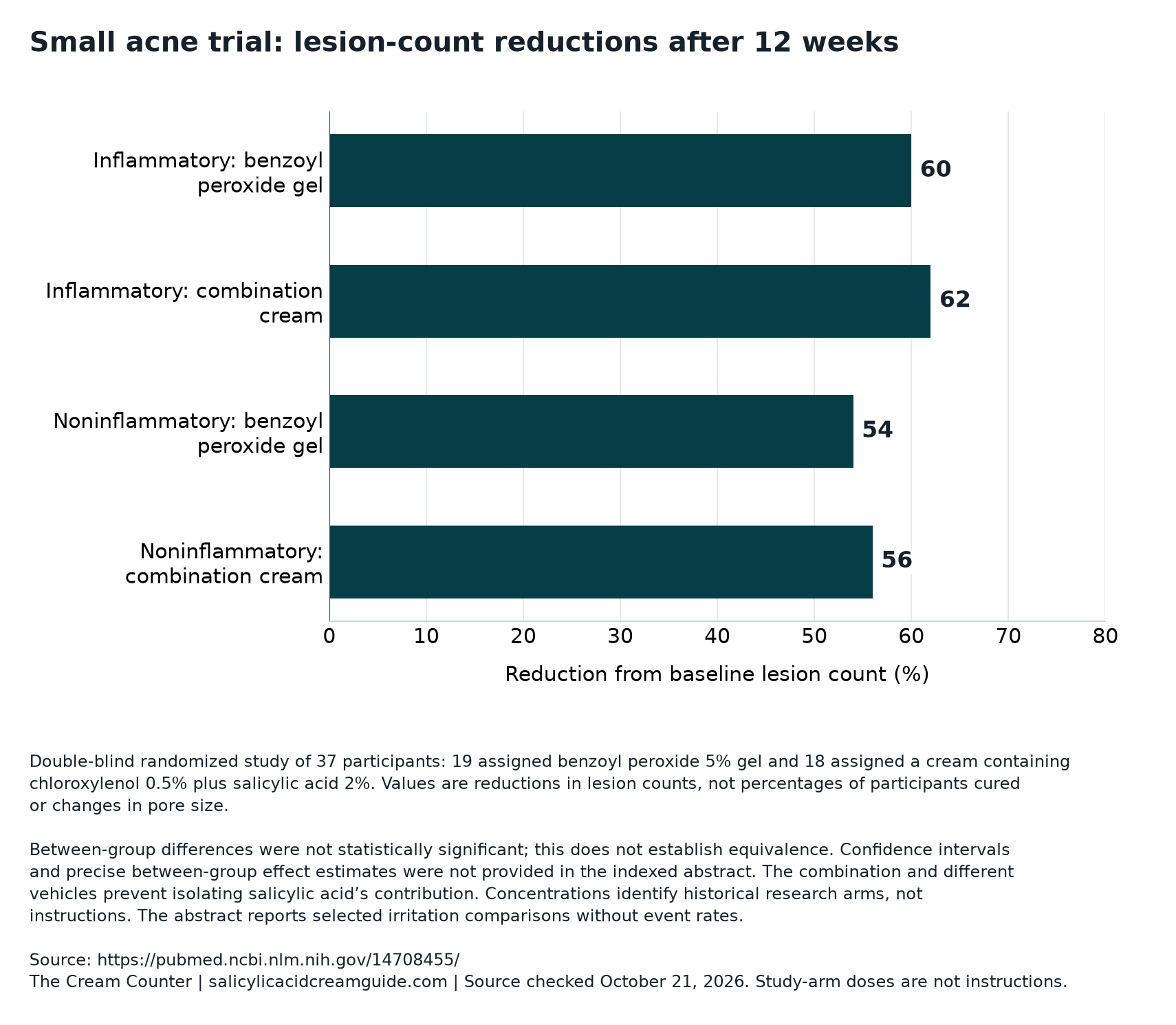
Lesion reductions: Inflammatory lesion counts fell 60% with benzoyl peroxide and 62% with the combination; noninflammatory counts fell 54% and 56%, respectively. Source 1
Statistical boundary: No statistically significant between-group difference was reported for lesion reductions. The abstract does not establish formal equivalence or provide confidence intervals. Source 1
Tolerability finding: Erythema and photosensitivity were reported as less frequent with the combination at week 12, but the abstract supplies no event counts or percentages. Source 1
Regulatory context: FDA's OTC acne monograph lists salicylic acid at 0.5–2% and benzoyl peroxide at 2.5–10%, subject to all applicable conditions; it is not product-specific approval. Source 4
What the 12-week comparison actually tested
Investigators randomly assigned 37 volunteers to two topical treatments in a double-blind study. Nineteen used 5% benzoyl peroxide gel; 18 used a cream containing 0.5% chloroxylenol and 2% salicylic acid, identified in the abstract as Nisal cream. Participants applied their assigned treatment to the entire face twice daily. These concentrations and application details describe the research arms, not instructions for another product or an individual treatment plan.
Clinical evaluations and lesion counts occurred at baseline and weeks 3, 6, 9, and 12. Repeated visits can reveal how a response develops rather than only its final size. However, the indexed abstract gives the clearest numerical results at week 12; it does not supply the intervening lesion counts, their variability, or a detailed trajectory for either arm.
The abstract does not identify a single prespecified primary endpoint, participant age distribution, baseline severity distribution, or sponsor. It also does not describe allocation concealment or how blinding was maintained across a cream and a gel. Randomization and double-blinding are reported design strengths, but those labels do not fill in unavailable methodological details.
Read the underlying chart data: download CSV or download the source-labeled chart.
Reading the lesion reductions without turning them into clearance
Inflammatory lesions include the papules and pustules counted in this study; noninflammatory lesions include comedones, such as blackheads and whiteheads. Both categories showed substantial reported reductions. The benzoyl peroxide group had a 60% inflammatory lesion reduction, compared with 62% for the combination. Noninflammatory reductions were 54% and 56%, respectively.
A worked example makes the scale easier to understand. If a hypothetical baseline count were 50 inflammatory lesions, a 60% reduction would leave 20, while a 62% reduction would leave 19. This illustration is not an actual participant result. It shows why a two-percentage-point difference in reduction should not be described as two fewer lesions for everyone, or as a two-percent chance of treatment success.
The reported percentages describe changes in lesion counts, not the proportion of people whose skin cleared. They do not show how many participants had near-clear skin, whether some improved much more than others, or whether visible scarring and dark marks changed. A favorable group result can coexist with considerable variation between individuals.
Reported week-12 lesion-count reductions in the 37-person trial
| Lesion category | 5% benzoyl peroxide gel | 0.5% chloroxylenol + 2% salicylic acid cream |
|---|---|---|
| Inflammatory lesions | 60% reduction | 62% reduction |
| Noninflammatory lesions | 54% reduction | 56% reduction |
| Difference between arms | Reference comparator | 2 percentage points greater reduction in each category; no statistically significant difference reported |
Why a nonsignificant result does not establish equivalence
The abstract reports no statistically significant difference between groups in reductions of papules/pustules or comedones. That means the analysis did not establish a between-group difference under its statistical approach. It does not demonstrate that the treatments have equal effects. A small study may fail to distinguish treatments because the true difference is small, because estimates are imprecise, or both.
Formal equivalence asks a different question: is the plausible difference confined within a prespecified range small enough to count as clinically unimportant? Answering that requires an acceptable margin and an analysis capable of testing it. The available abstract does not report an equivalence margin or confidence intervals, which would show the precision around the estimated differences.
The authors interpreted the cream as similarly effective and better tolerated. A more bounded reading is that the reported lesion reductions were close in this sample, with no detected efficacy difference. We cannot determine from the abstract whether the data also permit a meaningful advantage for either treatment. Nor can we calculate a number needed to treat from aggregate lesion-count reductions.
The missing ingredient controls matter
The combination arm contained two active ingredients, not salicylic acid alone. There was no salicylic-acid-only arm, chloroxylenol-only arm, or matching cream without either active ingredient. Consequently, the study cannot assign a particular share of improvement to salicylic acid, chloroxylenol, their interaction, or the treatment vehicle.
The cream-versus-gel comparison adds another unresolved variable. A vehicle is the base that carries the active ingredients; it can affect application experience and how a formulation behaves on skin. This study does not quantify those contributions. Randomization helps compare the assigned treatment packages, but it does not separate the ingredients within each package.
This is why a 2% declaration is not a bridge to every other salicylic acid product. The full-formula reading guide provides a practical way to keep ingredient identity separate from finished-product evidence. The trial's findings belong first to the formulations actually compared, rather than to any cream, gel, compounded preparation, or provider using the same headline percentage.
The tolerability signal is real but not a risk percentage
At week 12, the abstract reports fewer adverse effects of erythema, meaning redness, and photosensitivity in the combination group. The reported P values were 0.0002 for erythema and 0.05 for photosensitivity. These are specific comparative findings, not a basis for describing either treatment as free of adverse effects.
A P value is not the percentage of people who experienced a reaction. Without event counts, denominators, or severity details, those values cannot tell us how often redness occurred or how large the absolute difference was. Even a small P value does not supply the missing magnitude. The abstract also does not establish whether the week-12 result represents adverse events accumulated over all 12 weeks or findings assessed at that visit.
Because ingredients and vehicles differed together, improved tolerability cannot be credited specifically to salicylic acid. The findings also do not cover rare reactions or prolonged use beyond the study. For label-level distinctions between expected irritation and warnings that deserve a different response, see the salicylic acid irritation guide.
A separate trial asked what adding salicylic acid changes
A 49-patient study provides a more direct addition question, although it still does not test salicylic acid alone. This prospective, single-blind, randomized, 12-week trial enrolled patients with mild to moderate facial acne. It compared salicylic acid added to clindamycin phosphate plus benzoyl peroxide against the clindamycin–benzoyl peroxide regimen without that addition.
The abstract reports greater reductions favoring the salicylic-acid addition for inflammatory and total lesions throughout the study weeks, and for noninflammatory lesions beyond two weeks. Patient and investigator global improvement scores also favored the addition at study end. However, numerical effect sizes, confidence intervals, and the salicylic acid concentration are absent from the abstract. Statistical significance alone cannot tell readers how much extra improvement to expect.
The trade-off differed from the 37-person trial: transient mild to moderate dryness was more frequent with the salicylic-acid addition. Both regimens reduced measured outer-skin hydration, while skin sebum values decreased with the added-salicylic-acid treatment. Together, these results argue against a universal claim of better tolerability. The guide to salicylic acid and benzoyl peroxide keeps combination labeling distinct from evidence about a particular antibiotic-containing regimen.
A modified formulation and a split-face design answer another question
A third randomized study compared 2% supramolecular salicylic acid cream, a modified preparation, with a benzoyl peroxide–adapalene gel on opposite facial sides. It was open-label, single-center, and lasted 28 days, with 31 completers. Paired facial sides are useful for within-person comparisons, but they do not turn 31 people into 62 independent participants.
At day 28, inflammatory lesion reductions were 47.9% with the modified salicylic acid preparation and 49.8% with the comparator. Noninflammatory reductions were 43.1% versus 42.7%, and total lesion reductions were 44.1% versus 45.6%. None of those comparisons was statistically significant. As in the main trial, this does not prove equivalence. The shorter follow-up and different formulations also prevent a straightforward ranking across studies.
There is a concentration discrepancy within the indexed abstract: its title and methods identify 0.1% adapalene, but the objectives also state 0.01%. The table follows the title and methods, not independent full-paper verification. Our split-face study analysis examines this trial separately, including why nonsignificant between-side comparisons in skin measurements do not establish an absence of irritation or long-term harm.
Three studies, three different treatment questions
| Study design | Comparison | What the comparison addresses |
|---|---|---|
| 37 volunteers; randomized, double-blind; 12 weeks | Chloroxylenol 0.5% + salicylic acid 2% cream versus benzoyl peroxide 5% gel | Whole-formulation comparative results, not salicylic acid's independent contribution |
| 49 enrolled; randomized, single-blind; 12 weeks | Salicylic acid added to clindamycin + benzoyl peroxide versus that regimen without the addition | Incremental benefit and dryness from adding salicylic acid in this regimen |
| 31 completers; randomized, open-label, split-face; 28 days | Supramolecular salicylic acid 2% cream versus benzoyl peroxide 5% + adapalene 0.1% gel, as stated in title and methods | Short-term paired comparison of a modified preparation; abstract also contains a conflicting adapalene concentration |
The monograph does not approve the trial cream
FDA's OTC acne monograph lists salicylic acid concentrations of 0.5–2% and benzoyl peroxide concentrations of 2.5–10%. Those ranges provide regulatory context for acne drugs, not evidence that every formulation within them has the same clinical performance. Conformity depends on all applicable conditions, not merely placing a listed percentage on a label.
The monograph is also not product-specific FDA approval. The presence of 2% salicylic acid in the trial cream does not, by itself, establish the regulatory status of the whole chloroxylenol combination. Likewise, the study is not prescribing information for another product. Its evidence concerns facial acne lesions, not permanent pore shrinkage, wrinkle correction, or treatment of unrelated bumps.
FDA's cosmetic BHA page describes salicylic acid in an exfoliation context. That is a different evidentiary setting from an acne-drug trial. Its historical discussion of an industry safety assessment should not be converted into a present-day product approval claim. The face-versus-body guide explains why the labeled purpose matters alongside the acid percentage.
Rare hypersensitivity is different from routine dryness
FDA has warned about rare serious hypersensitivity reactions associated with some OTC acne products containing salicylic acid or benzoyl peroxide. These reactions are different from ordinary local dryness or irritation. The agency could not determine whether active ingredients, inactive ingredients, or both caused the reported reactions.
Its historical review identified 131 reports through January 28, 2013, including 58 hospitalizations and 50 reports categorized as anaphylactic. These are selected spontaneous reports, not a measured rate among users. Without the number of exposed people, neither a population risk percentage nor a fair comparison between ingredients can be calculated.
FDA advises stopping the product and seeking emergency care for throat tightness, breathing difficulty, faintness, or swelling of the eyes, face, lips, or tongue. Small-area sensitivity checks do not guarantee that a later allergy will not occur. These warnings complement the trial evidence: 37 participants followed for 12 weeks cannot settle uncommon serious risks, even when one arm has fewer reported local effects.
How the evidence should shape product comparisons
The most defensible comparison starts with a formula match: active ingredients, concentrations, vehicle, treatment setting, and duration. A product that shares only salicylic acid with the study cream has a partial ingredient connection, not direct clinical validation. Neither another route nor a compounded formula inherits the trial's lesion reductions or tolerability results.
Editorial interpretation: commercial terms should be examined separately from clinical evidence. Readers checking documentary terms can consult the CoreAge Rx review and Likeness Rx review. Those reviews are not evidence that either provider offers the studied formulation, reproduces the trial's care, or delivers its outcomes. A purchasing or renewal arrangement cannot resolve an unanswered scientific comparison.
The next useful study would separate ingredient contributions with appropriate control arms, report baseline counts and distributions, and provide confidence intervals and adverse-event frequencies. Longer follow-up would address persistence of benefit and tolerability. Until then, the main trial supports a promising comparison between two specific treatment packages, while leaving the contribution of salicylic acid itself unresolved.
Questions about the evidence
Did the combination cream beat benzoyl peroxide?
Its reported lesion reductions were numerically greater by two percentage points in each reported category, but the between-group differences were not statistically significant. The abstract therefore does not establish superior efficacy. It reports fewer erythema and photosensitivity effects at week 12, without enough numerical safety data to calculate absolute risk differences.
Does a 62% reduction mean 62% of participants cleared?
No. It describes the reported reduction in inflammatory lesion counts, not the percentage of participants who became clear. A group can have a large reported count reduction while many participants retain lesions. The abstract does not provide a patient-clearance rate or enough individual data to reconstruct one.
Does the addition trial prove salicylic acid is always helpful in combinations?
No. It supports an incremental benefit in the particular clindamycin–benzoyl peroxide regimen studied over 12 weeks. It also found more transient dryness with the addition. The abstract lacks the numerical effect sizes and salicylic acid concentration needed to translate that result into a broad claim about every combination product.
Can the supramolecular study validate an ordinary 2% cream?
Not directly. It tested a modified salicylic acid preparation in a 28-day split-face comparison. Matching the percentage does not establish matching formulation behavior or clinical results. Its nonsignificant comparisons and skin measurements also do not prove equivalence, long-term safety, or permanent changes in pore size.
Is an ingredient listed in the OTC monograph the same as an approved product?
No. The monograph sets conditions for eligible OTC acne products, including specified ingredients and concentrations, but compliance requires all applicable conditions. It is not individual product approval, and it does not show that a particular cream was tested in the 37-person trial or will reproduce that trial's results.
What this evidence supports
The 37-person randomized trial provides a useful but limited whole-formulation comparison: substantial reported lesion reductions in both arms, no detected efficacy difference, and a week-12 tolerability signal favoring the chloroxylenol–salicylic acid cream. It does not isolate salicylic acid, establish formal equivalence, or quantify adverse-event risks. The addition and split-face studies strengthen the case for asking formulation-specific questions rather than treating every salicylic acid percentage as interchangeable. For product evaluation, the sound conclusion is specificity: match the evidence to the treatment actually studied, and leave unsupported ingredient-level promises unclaimed.
Research access and limitations
Clinical analysis is based on indexed primary study abstracts, not examination of complete protocols, supplements, or all full texts. The accessible abstracts do not provide confidence intervals or sponsor information. Important details about attrition, outcome prioritization, and adverse-event frequencies remain unavailable. Official FDA materials supply regulatory and safety context, not contemporary product-specific prescribing information or confirmation of any commercial formula.